
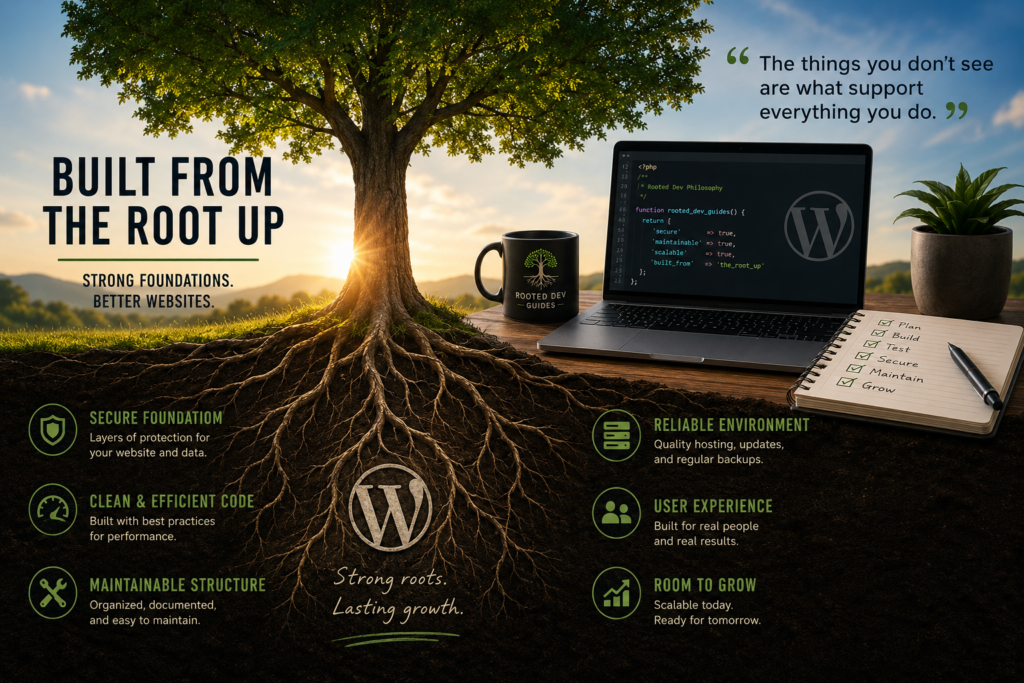
“Built from the root up” is more than a phrase I use for the Rooted Dev Guides.
It represents the way I have learned to approach development, security, business websites, and even learning itself after more than 14 years working in web development.
When something is built well, the parts people see on the surface are only part of the story.
Behind a professional website is structure.
Behind reliable software is planning.
Behind good security is a series of deliberate decisions.
Behind clean code is an understanding of the problem that code is supposed to solve.
That is what built from the root up means to me.
Start With the Foundation
A tree can only grow as strong as the system supporting it beneath the ground.
Websites are not much different.
It is easy to focus on what visitors see:
- Colors
- Images
- Animations
- Buttons
- Layouts
- Features
Those things matter.
But underneath them are the decisions that determine whether the website will remain fast, secure, manageable, and useful months or years later.
What hosting environment is being used?
How is the website structured?
Which plugins are necessary?
How is customer information handled?
Who has administrator access?
Are backups being created?
Can those backups actually be restored?
Is the code maintainable?
Can another developer understand what was built?
What happens when WordPress changes?
Those questions may never appear on the homepage, but they are part of the foundation that supports everything visitors do see.
Understanding Before Adding
One of the biggest lessons I have learned throughout my career is that adding more is not always the answer.
More plugins do not automatically create a better WordPress website.
More features do not automatically create better software.
More animations do not automatically create a better user experience.
More security tools do not automatically create a secure system.
Before adding something, I like to understand what problem it is supposed to solve.
Sometimes the right solution is a new feature.
Sometimes it is better architecture.
Sometimes it is removing something unnecessary.
Sometimes it is fixing the foundation underneath the problem instead of covering it with another layer of software.
Building from the root up means understanding why something is needed before deciding how to build it.
Security Is a Perfect Example
Security is one of the clearest examples of this philosophy.
A business owner may ask which WordPress security plugin they should install.
There are useful security plugins, and many can be valuable parts of a professional website.
But installing one plugin does not suddenly make everything underneath it secure.
Strong website security may involve:
- Secure hosting
- WordPress updates
- Trusted themes and plugins
- Strong user access controls
- Two-factor authentication
- Proper permissions
- Secure coding practices
- Monitoring
- Backups
- Recovery planning
- Firewall protection
- Responsible maintenance
Those protections work together.
That is why I often describe security as something that should be built from the root up rather than installed at the end.
The same principle applies to performance, accessibility, maintainability, and usability.
Good Development Should Survive Tomorrow
A website does not stop changing when it launches.
WordPress changes.
PHP changes.
Browsers change.
Business needs change.
Security practices change.
Clients request new features.
Products grow.
Developers eventually revisit code they wrote months or years earlier.
That means professional development should not only answer:
Does it work today?
It should also ask:
Will this still be understandable and maintainable tomorrow?
Clean structure matters.
Documentation matters.
Naming matters.
Separating responsibilities matters.
Following platform standards matters.
Avoiding unnecessary complexity matters.
I have learned that development decisions that save a few minutes today can sometimes create hours of problems later.
Building from the root up means thinking beyond the immediate feature.
It Also Applies to Learning
The phrase is just as important when learning development.
It is tempting to jump directly to the result.
Copy the function.
Install the package.
Follow the tutorial.
Paste the code.
And sometimes that is enough to accomplish a task.
But there is a big difference between making something work and understanding why it works.
That difference becomes important when something breaks.
If you understand the foundation, you can troubleshoot.
You can adapt.
You can recognize patterns.
You can build something new instead of only reproducing something someone else already created.
That is one of the reasons I created the Rooted Dev Guides.
I do not want the books to simply give readers steps to copy.
I want them to help readers understand the thinking underneath those steps.
Knowing Why Changes How You Build
Consider WordPress plugin development.
You can learn how to add an action hook.
That is useful.
But understanding the WordPress event system and why hooks exist gives you the ability to decide where your functionality belongs.
You can learn to add a nonce to a form.
That is useful.
But understanding what the nonce helps protect—and what it does not protect—makes you a better developer.
You can learn how to create a theme template.
But understanding what belongs in a theme and what should remain inside a plugin creates a better long-term product.
That is what I want readers to take away from these guides.
Not only:
Here is the code.
But:
Here is why we are building it this way.
Real Businesses Need Strong Foundations Too
My years working with businesses have reinforced this philosophy.
A small-business owner may not care whether their website uses a particular PHP class or WordPress API.
They should not have to.
What they care about is whether:
- Customers can find them.
- The website loads quickly.
- Contact forms work.
- Leads actually arrive.
- Their information stays protected.
- The website works on a phone.
- Updating the site does not break everything.
- Someone can maintain it.
- The website helps the business grow.
Those results depend on technical decisions the business owner may never see.
That is why good development matters.
Technology should support the business rather than become another problem the business owner has to manage.
Simple Does Not Mean Basic
I also believe building from the root up often leads to simpler solutions.
But simple should not be confused with incomplete.
A simple solution can be extremely well designed.
It can be secure.
It can be scalable.
It can be fast.
It can be easier to maintain.
It can solve exactly what the customer needs without unnecessary features getting in the way.
Some of the best development decisions are the ones users never notice because everything simply works the way they expect.
The Roots Should Be Strong Enough to Grow
The second part of the idea is growth.
A strong foundation should not trap a project.
It should give the project somewhere to go.
A plugin may begin with one useful feature and eventually develop into a larger product.
A small-business website may begin with five pages and later add ecommerce, bookings, customer accounts, or additional locations.
A developer may begin learning basic PHP and eventually build commercial WordPress products.
Good foundations make that growth easier.
Poor foundations make every new addition harder.
So when I think about building something from the root up, I am not only thinking about what exists today.
I am thinking about what it may become.
Why the Tree Became Part of the Brand
That is also why the tree and root imagery fits Rooted Dev Studio and the Rooted Dev Guides so naturally.
A healthy tree has visible growth above the surface, but that growth depends on something much larger underneath it.
The roots provide structure.
They provide stability.
They support continued growth.
For me, that is a good representation of development.
The final website, application, theme, or plugin is what people see.
The architecture, experience, security practices, code quality, planning, and maintenance are the roots supporting it.
What I Want the Rooted Dev Guides to Represent
As the series continues to grow, I want every Rooted Dev Guide to follow the same philosophy.
Start with the foundation.
Explain the reason.
Build carefully.
Keep it practical.
Avoid unnecessary complexity.
Think about security.
Think about maintenance.
Think about the person who will actually use what is being built.
And leave the reader with knowledge they can continue building on after the final chapter.
Because learning technology is not about reaching a point where you know everything.
That point does not exist.
It is about developing a strong enough foundation that you can continue learning, adapting, solving problems, and growing as the technology around you changes.
That is what built from the root up means to me.
It means understanding what supports the things we build.
It means valuing the foundation as much as the finished product.
And it means creating something strong enough to keep growing.
Built from experience. Rooted in better code.
Guides that help you grow.