
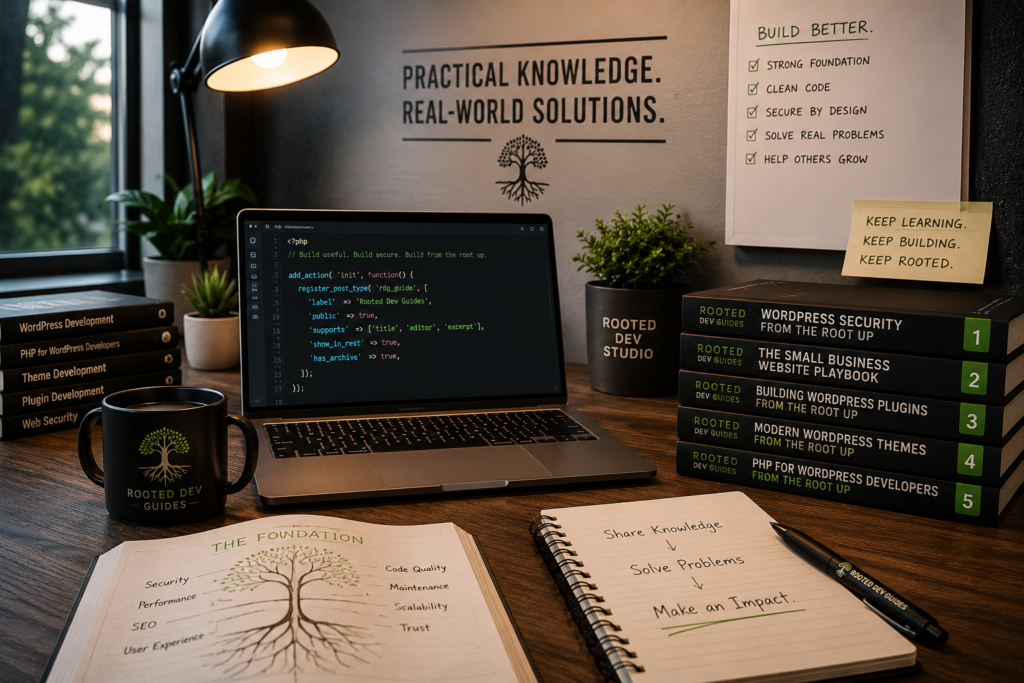
For more than 14 years, web development has been more than a job for me. It has been a career built around solving problems, learning new technology, working with businesses, writing code, and figuring out better ways to build things for the web.
Over those years, I have worked extensively with WordPress, themes, plugins, custom development, website security, performance, maintenance, and the many challenges that come with managing real-world websites. I also spent years working as a Director of Web Development for a marketing company in Peoria, Illinois, where I had the opportunity to work with businesses ranging from small local companies to larger organizations.
Those experiences eventually led me to ask a simple question:
What could I do with everything I have learned to help someone else?
That question became the beginning of the Rooted Dev Guides.
Experience Is Valuable When It Can Be Shared
A lot of what you learn as a developer never comes from a single class, tutorial, or documentation page.
It comes from experience.
It comes from debugging something that worked yesterday but suddenly stopped today.
It comes from working with a business owner who knows exactly what they need their website to accomplish but does not know how to translate that goal into technology.
It comes from discovering that the most complicated solution is not always the best one.
It comes from maintaining websites long enough to understand that the decisions you make during development can affect performance, security, usability, and maintenance years later.
Those are lessons that take time.
I wanted the Rooted Dev Guides to give readers access to some of those lessons without requiring them to spend 14 years discovering every one of them the hard way.
I Wanted Something More Practical
There is an incredible amount of technical information available online.
That is a good thing.
But technical information can also become overwhelming very quickly.
A person searches for help with WordPress security and receives dozens of conflicting answers.
A new developer wants to build a plugin and finds documentation explaining individual functions but struggles to understand how everything fits together into a real product.
A small-business owner wants a better website but gets buried beneath terminology that means very little to someone who simply wants more customers to contact the business.
I wanted to approach these subjects differently.
The goal of the Rooted Dev Guides is not to impress readers with complicated terminology.
The goal is to make technical subjects understandable, practical, and useful.
I want someone to finish a chapter and be able to say:
“I understand why this matters, and I know what I can do next.”
That is far more valuable to me than simply filling pages with technical definitions.
Why “From the Root Up”?
The name represents the way I have learned to think about development.
Good websites start with a good foundation.
Good security starts with a good foundation.
Good plugins start with good architecture.
Good themes start with thoughtful design decisions.
Good code starts with understanding the problem before writing the solution.
You can add features, plugins, visual effects, and tools forever, but if the foundation underneath them is weak, eventually those weaknesses start showing.
That philosophy became a central idea throughout the series:
Build the foundation correctly. Understand what is underneath it. Then grow from there.
That is also why the Rooted Dev Guides connect so naturally with Rooted Dev Studio.
Both are built around the same idea: practical technology supported by experience and stronger development foundations.
The First Books Established the Mission
I started the series with WordPress Security From the Root Up because security is an area where I believe the wrong question is often asked.
People frequently search for the “best WordPress security plugin.”
A good security plugin can absolutely help, but no single plugin should be responsible for protecting an entire website.
Real security comes from layers: hosting, updates, software choices, user access, development practices, backups, monitoring, recovery planning, and security tools working together.
That idea became the foundation of the first book.
The second book, The Small Business Website Playbook, approached websites from another direction.
Instead of focusing primarily on developers, it focuses on the business behind the website.
A website should not simply sit online looking professional.
It should help people understand the business, build trust, find services, make contact, and take action.
That book grew from years of seeing what businesses actually need from their websites.
From there, the series naturally moved deeper into development with guides on WordPress plugin development, modern theme development, and PHP for WordPress developers.
Each book builds on the same philosophy while serving readers at different stages of their journey.
I Want the Books to Be Useful to Different Readers
Not everyone reading a Rooted Dev Guide will be a professional programmer.
Some readers may own a small business.
Some may be learning WordPress.
Some may be freelancers trying to strengthen their skills.
Some may already be developers but want a better understanding of security, plugin architecture, themes, PHP, performance, or other specialized areas.
That is why I try to write with both clarity and depth.
I do not want to remove the technical information developers need.
I want to explain it in a way that makes the reasoning behind it easier to understand.
Knowing how to do something is useful.
Understanding why you should do it that way is what helps you become better at solving problems on your own.
These Guides Are Also About Confidence
One of the hardest parts of learning technology is reaching the point where you trust yourself to solve a problem.
At first, everything feels unfamiliar.
Every error message looks serious.
Every new API feels complicated.
Every mistake makes you wonder whether you are doing something wrong.
Eventually, experience changes that.
You begin recognizing patterns.
You learn how to troubleshoot.
You understand where to look.
You stop expecting yourself to memorize everything and start trusting your ability to find, understand, and apply the information you need.
If the Rooted Dev Guides can help someone reach that point a little faster, then they are accomplishing what I want them to accomplish.
This Is Only the Beginning
There are many more subjects I want to explore through the series.
WordPress development continues to evolve. Security practices change. PHP changes. New APIs appear. Development workflows improve. Business websites continue to face new challenges.
That gives me plenty to write about.
But regardless of how large the series becomes, I want the purpose to remain the same.
The Rooted Dev Guides are about taking real-world development experience and turning it into knowledge other people can use.
Not shortcuts.
Not hype.
Not unnecessary complexity.
Just practical guidance designed to help people understand technology better, build stronger websites and products, and keep growing their skills.
That is why I started writing the Rooted Dev Guides.
And it is why I plan to keep writing them.
Guides that help you grow.